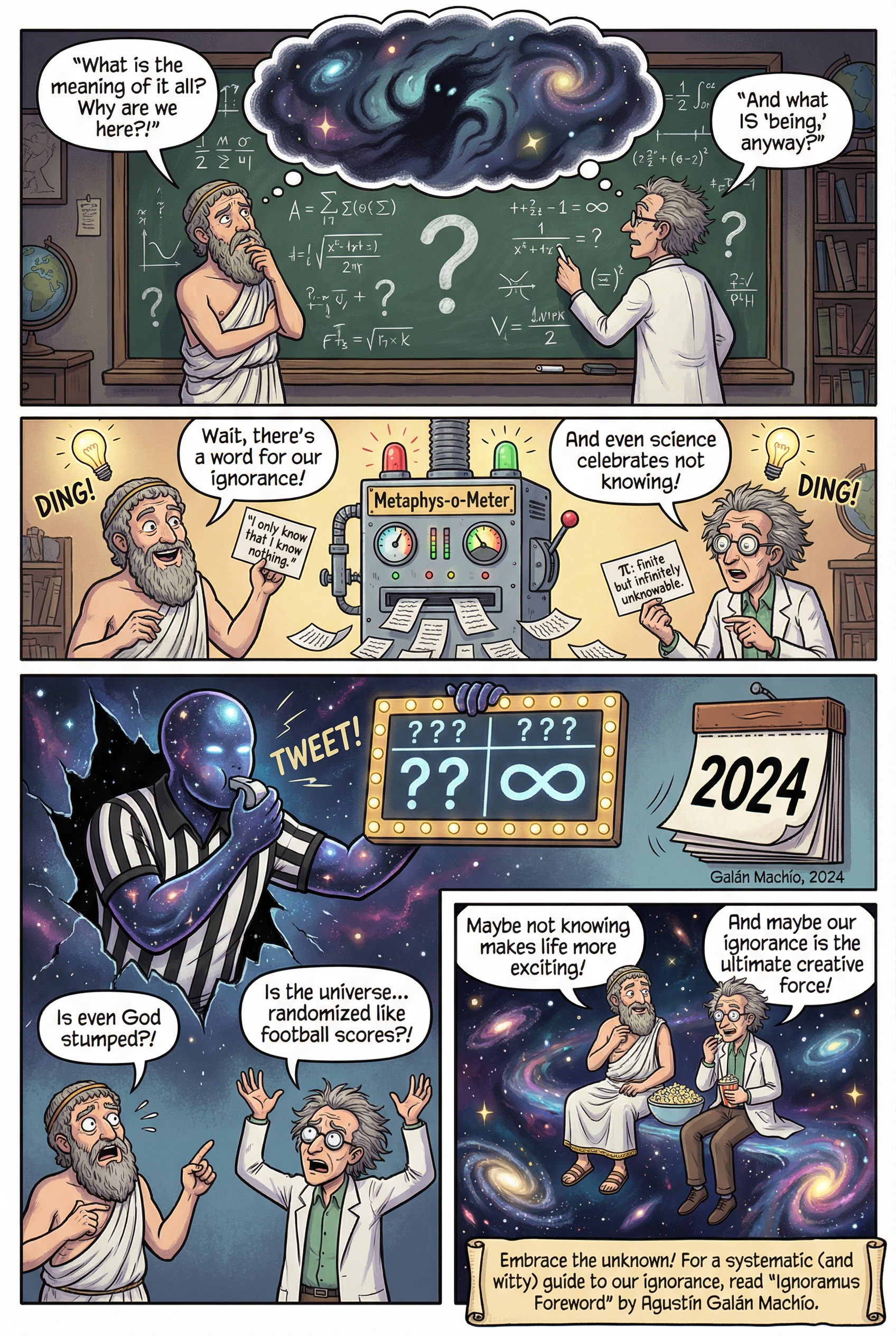
Emil du Bois-Reymond introduced the Latin phrase Ignoramus et ignorabimus (“we do not know, and we will not know”) in his book The Seven Enigmas of the Universe. There, he argued that when human reason encounters the logical limits of thought, the fundamental problems governing the functioning of the universe prove to be insoluble. This expression subsequently became a motto of modern agnosticism. Despite the remarkable advances achieved in quantum physics, precision cosmology, and the standard model of the Big Bang, agnosticism remains a defensible epistemological position. This conviction underlies the title of the present book, whose aim is to systematize the epistemological skepticism characteristic of postmodernity.
The book offers a systematic overview of the scope of our current philosophical and scientific ignorance. To this end, it presents a collection of aphorisms and concise statements that delineate the boundaries of our alleged knowledge and ignorance concerning the concept of Being.
At its core, the argument may be summarized in two propositions. First, the ultimate fate and purpose of the world are unknown. Second, even God may not possess such knowledge. The text further suggests that uncertainty—about the end of our lives, much like the outcome of a football match—is precisely what enhances our enjoyment of them.
The work is structured as a series of brief, self-contained statements designed to facilitate readability. Alongside philosophical propositions—here described as philosophical aphorisms—the author includes other sentences addressing both our ignorance and our scientific understanding of the universe.
For the latter, he proposes the term scientologism, derived from the Greek word for “science.” For the former, he introduces agnoiologism, derived from agnoiology (from the Greek ἀγνοέω, meaning “to be ignorant”). An agnoiologism denotes a statement that reflects our limited understanding of the nature of Being and the conditions under which ignorance itself is produced.
Click here:
https://www.academia.edu/145654730/Ignoramus_foreword?source=swp_share

 Inicio/Agustín Galán Machío
Deja un comentario